
Beauty & the Fine Arts

A Response to Dr. Forman's Questions on the Arts at John Adams Academy
by Greg Blankenbehler, M.A. Mus.
If I speak with human eloquence and angelic ecstasy but don't love, I'm nothing but the creaking of a rusty gate.
If I speak God's Word with power, revealing all his mysteries and making everything plain as day, and if I have faith that says to a mountain, "Jump," and it jumps, but I don't love, I'm nothing.
If I give everything I own to the poor and even go to the stake to be burned as a martyr, but I don't love, I've gotten nowhere.
So, no matter what I say, what I believe, and what I do, I'm bankrupt without love.
1 Cor 13:1-7, MSG version
Beauty is a severely misunderstood concept in our world today. In order to identify how it manifests itself at John Adams Academy, I must first take some time to identify what I think Beauty really is.
What Beauty Is
Beauty is one of the triune transcendentals that philosophers and moralists have observed and pondered for millennia: Truth, Beauty, Goodness - the pinnacle and pure essence of all the many different values we seek. They are transcendentals because they shine through the best of all things as a deeper truth or order to the diverse manifestations of reality. They are triune because they are in reality three different perspectives of the same ideal. What is True is also Beautiful and also Good. They are ideal and difficult to exhaustively define or circumscribe because, I believe, they are the very personality, nature, and character of God. Truth, Beauty, and Goodness are ideals that we as humans can never fully live up to, fully explain, or even fully understand. But our efforts to understand and live up to them represent the greatest learning and acts that the human race have ever produced.
At its best, our society's concept of beauty is deeply entwined with individual preference. ("Beauty is in the eye of the beholder.") But how can we even talk about beauty when what I think is beautiful is different from what you think is beautiful? At its worst, our society's concept of beauty focuses on animal attraction, capturing the things that titillate our senses and consuming them in a rush of selfish debauchery. But if Beauty is the same as Truth and Goodness, how could Beauty contradict them so strongly at times? How could many of the most "beautiful" people be so cruel and the most truthful and good "ugly"? It is good to ask ourselves these questions because they are the jumping off point to developing moral and aesthetic maturity.
Clearly much of our society is missing the point when it comes to beauty. Roger Scruton does a great job of explaining this concept in his BBC documentary "Why Beauty Matters." True beauty is experienced, for example, by women who gather around a young baby who is happily laughing and cooing. Why is that baby beautiful to them? They don't want to consume the baby. They don't want to make any money off it. The baby won't do anything for them. It is useless. And yet, that baby is as full of truth and goodness as you can get. Full of potential and love of life. Experiencing that baby inspires those women to also live their own truth and potential to the fullest. We are affected similarly by beautiful vistas of nature, striking portrayals in dramas, a sense of the mathematical order of the world, a philosophical discussion that seems to get to the heart of why humans act the way they do and how they can live their lives to their full potential. Anytime we experience thriving nature (and that includes human nature), we are moved by the beauty of it.
Beauty is not lust, but it attracts us because it inspires. Beauty is not propaganda or pedantic moralizing, but it educates and motivates us on how to live better. Beauty is not a superficial thing one can paint on their face, shape their body into, or social protocols one can learn. It is living with truth and goodness, being true to the highest ideals within one's self and truly loving others. Rembrandt and others painters prove this by showing beauty in the most ordinary, old, and marred of faces. This is also proven (in a negative way) by many a fashion advertising image in which a haughty airbrushed figure attempts to solicit your interest in order to relieve the weight of your pocketbook.
Where Is Beauty at John Adams Academy?
Once you know what Beauty really is, you can find it all over, but it is not where you might expect it if you don't know what it is.
Classics Beauty is present in the great classics that we study and discuss at John Adams Academy. A great book like Les Misérables or The Brothers Karamazov helps us to experience the deeper truths of human nature (both the good and the bad), and shows us how to participate in Goodness. Great dramas, songs, and paintings do the same. Seeing the feelings and actions of people just like us, sympathizing with their situations, understanding their choices (even the bad ones), and feeling genuine joy at their redemption fills us with the feelings of enlightenment that is the aesthetic experience.
Contemplating and Discussing As teachers and scholars begin to uncover and understand the beauty in classics -- and in their everyday lives -- the light of beauty begins to dawn upon their countenances as well. As they identify and understand, they contemplate and analyze these holy transcendentals; compare them to other works and situations; evaluate their own actions and what beautiful and good things they could also do in their lives. Aesthetic and moral maturity grows in these scholars, and the beauty they develop is evident to those around them.
Creating It does not take much experience with beauty before scholars are seeking to imitate it; to grow their own ideas and projects of Beauty. This manifests through more original ideas and applications in discussions, creative writing, works of art, etc. All lovers of beauty are also lovers of Truth and Goodness. They seek out the deeper truth in themselves, in others, in history and science, institutions and systems of belief. They freely share what they have discovered with others.
Living Probably the best manifestation of Beauty (and the one I like best) is in the interpersonal lives of the staff, faculty, and scholars at John Adams Academy. You can't really learn about real Truth-Beauty-Goodness without putting it on yourself -- becoming it to a degree. I see Beauty every day at JAA in scholars that smile at one another and invite them to feel a part of the community. Scholars who open up about their anxieties and challenges and feel support from each other. Scholars who squeeze the hand of another, put an arm around their shoulder, encourage them to keep trying, tell them in so many ways that they are lovable just for being who they are. In my opinion, there is nothing more beautiful, good, or true than that.
It is the birthright of all humans to appreciate and imitate Beauty, but it is not necessarily something that comes automatically. There is beauty on all levels of perception and understanding, and it often takes a good deal of training and experience to appreciate the more sophisticated and sublime manifestations of it.
Perception
One way of looking at education is as a training in how to see Truth-Beauty-Goodness in various areas and degrees. The natural sciences and visual arts train us on how to see the truth/beauty of our natural world. The humanities, and the performing arts show us how to see the truth/beauty of human nature. Mathematics and the more abstract sciences show us the truth/beauty of the underlying order of the natural world. And so on . . . it is the job of every teacher of every subject to open the eyes of her scholars to the previously-invisible Truth-Beauty-Goodness of that part of reality.
This is an especially important job in the arts, an area that creates imitations or models of the "contours" of reality through a medium of expression. That could be painted shapes on a canvas that represent whole landscapes of mountains and rivers, dialogues on stage that suggest an infinitely complex web of individual and interpersonal lives, and songs and poetry that hint at subtle and otherwise inarticulate emotions and sensations. Since the smallest object in reality is still too complex to reproduce in full detail, the arts uses media (paint, clay, pitches, rhythms, gestures, expressions, etc.) to "render" reality and emphasize the aspects of Beauty that the artist wishes to point out the observer. It takes a good deal of training, experience, and reflection to increase one's aesthetic preceptive abilities.
Imitative Skills
As I mentioned before, once a person identifies and appreciates Beauty, there is always a drive to try to more intimately experience it themselves by imitating it. Those who do have experience in imitating Beauty can more fully appreciate it in the creative imitations of others. This is especially the case in the arts. The sculptor who has worked in the language of three-dimensional human form is the best equipped to understand the expression of beauty in Michelangelo's Pieta. Even a little dabbling in creating art goes a long way in better understanding the ongoing Great Discussion on Truth-Beauty-Goodness in that particular arts genre.
For the musician, these skills of course include: ear-training in pitch, harmony, rhythm and meter; reading and writing music; musicianship experience with dynamics, texture, and musical form; technical and expressive experience in singing and/or instruments; etc. For the actor, these skills include: diction, vocal tone and inflection, pacing, facial expression, physical gesture, dancing, etc. For the visual artist: skill with the pencil, pen, brush, chisel, or computer; understanding of the principles of visual art including color, shape, texture, perspective, etc.
Connecting Skills and Beauty
A drawing without skill cannot be good art because it fails to effectively imitate the subject it is portraying. Likewise, a skilled drawing without underlying Truth of Beauty cannot be good art because it portrays the physical aspects of the subject without any deeper meaningful aspects of it. This is why an artistic drawing has the ability to evoke aesthetic feelings while a technical drawing typically does not. In developing both technical and aesthetic skills, great artists traditionally experience the following areas of growth:
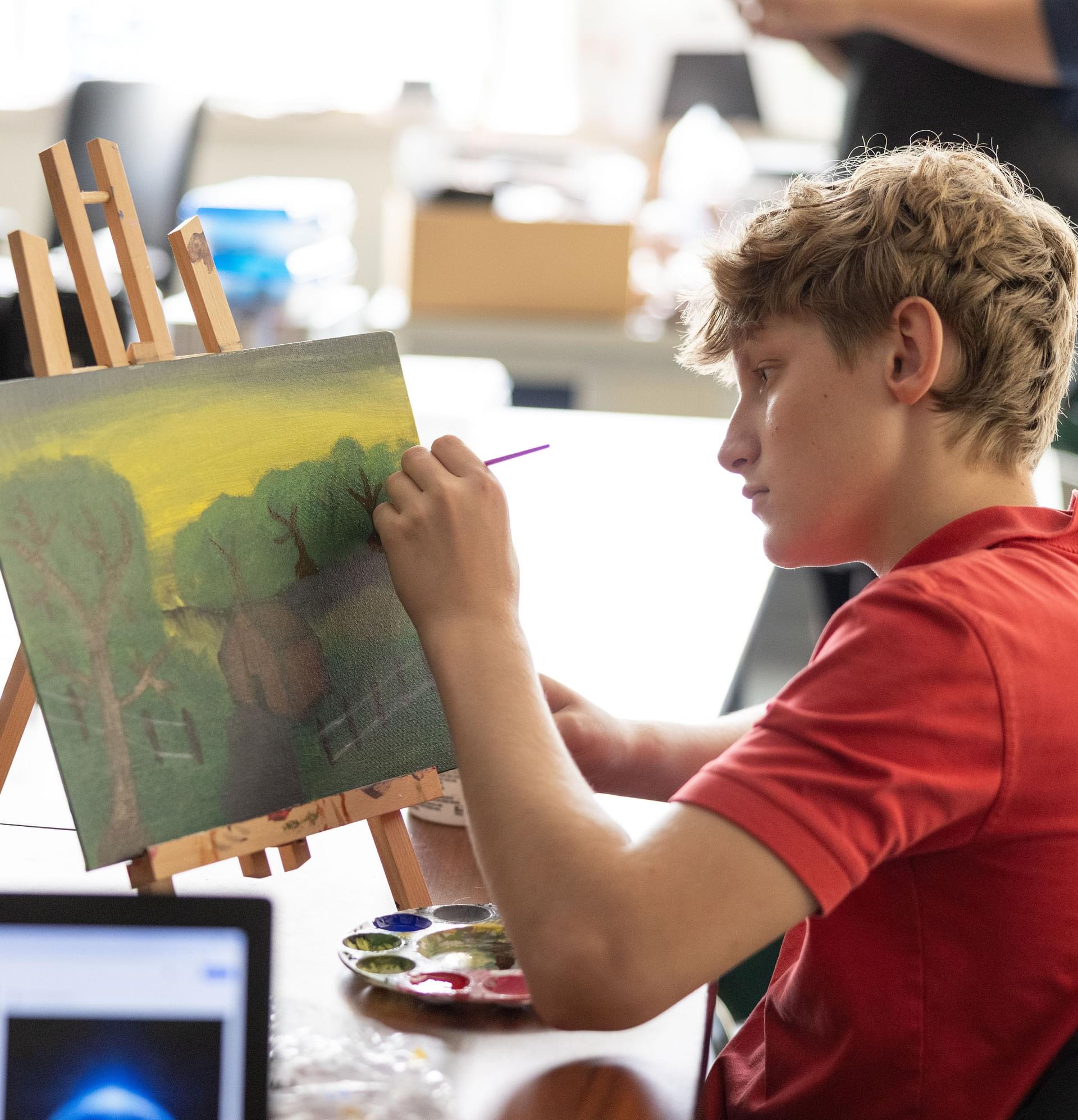
Imitation and Rudimentary Skill Development Early on, this is traditionally accomplished in all of the arts through the instruction and model of the master artist. Piano teachers lead their scholars through daily training drills and demonstrate with their own playing how to breathe life into a Chopin etude. Aspiring painters likewise were traditionally apprenticed to a master painter and learned daily how to paint simpler to more complex things under their careful tutelage. It has always been common to see young painters with their easels at art galleries copying great works of art on display. This is one thing the general public often misunderstands about artistic excellence: it is not so much granted by a favorable fairy at birth, but rather developed minute by minute through good role models, coaching, and an astonishing amount of practice.
Self-Discovery Great art, however, cannot come from simply imitating another artist. In addition to perfecting their technical and artistic skills, every great artist must go out into the world and discover the Beauty and Truth to be found out there, and delve deep into their own selves to discover the Beauty and Truth to be found inside themselves. This concept is wonderfully demonstrated in Letters to a Young Poet, a collection of correspondence from the experienced poet Rainer Maria Rilke to his younger colleague Franz Xaver Kappus. In these letters, Rilke repeatedly encourages Kappus to live life with his eyes wide open, experiencing and carefully noting the Truth and Beauty it has to offer. This includes deeply examining his own thoughts, feelings, and sensations, and expressing the genuine aesthetic experiences he has through his art. That is the only way to create original and authentic art that moves others.
Performance/Presentation The creation of great art is never a "safe" endeavor. It requires the bold exploration of Truth (both within and without) and bravery in presenting it to a potentially hostile world for their contemplation. The artist grows in skill and eloquence by repeating the artistic process again and again, creating more and more art. Each step can feel like a "leap of faith" or a "baptism of fire," but the successful artist is courageous and inventive in repeatedly turning out works of personal, authentic art.
Evidence of Aesthetic Skills Development
According to Roger Scruton ("Faking It"), ever since Duchamp's infamous inverted urinal, the modern art world has created a racket in which disingenuous artists create silly or disgusting art that they claim is profoundly meaningful, insincere art critics publish fawning articles praising their "originality" and aesthetic genius, and art museums spend millions of dollars of taxpayer and patron money to put those artworks on display, thereby "proving" to everyone that the artwork (and the artist, critic, and purchaser) is worth so much. And so, Scruton asserts, the indecently dressed emperor continues to be praised for his non-existent clothing. This great art con continues to repeat itself because no one seems to know what great art is anymore. No one knows what great art is because anyone can claim to have created or experienced art that generates profound aesthetic experiences, but it is much harder to prove it, especially in a society that values individualism and diversity.
This dilemma reproduces itself in our scholars' classrooms. If technical skill cannot reliably assure a great artist, and we can't just take people's word that they are truly having great aesthetic experiences, how can we recognize if our scholars are making or experiencing great art, or at least progressing towards it? The solution to this problem is to be found in the classical model. It is really very simple: great art elicits profound and generative meaning, which comes out in personal reflections and discussions. If, due to problems with its execution or subject matter, a work of art fails to mean much to a group of aesthetically-skilled observers, it fails to be a great work of art. (Sometimes it does take an "interpreter" to show the world the meaning in certain works of art, but the fact that the work of art is able to generate meaning after the individual helps society to see it still proves my point.) Likewise, the clearest evidence that a scholar or anyone has developed aesthetic sensibility is their ability to perceive, interpret, analyze, and synthesize the deeper meanings of Truth, Beauty, and Goodness in a demonstrably great work of art. You can tell if a scholar (or adult) has developed aesthetic sophistication in the way they discuss the piece: they excitedly make connections to other great classics, to themselves, and to fundamentals of the human experience. In the most profound interactions with Beauty, you can see the moral and existential effect that the work of art has on their lives moving forward. It is barely a metaphor to say that they "glow" with the enlightenment of Truth-Beauty-Goodness.
Without a doubt, the biggest challenge of creating and growing a robust fine arts program is the lack of aesthetic knowledge and sophistication in many of the scholars, parents, staff, and administration. When people don't know what good art is or what it is for, they have little respect for it and either push for entertainment and utilitarian outcomes, or to cancel it outright.
What is the Point of the Arts?
It is not surprising that even the decently-educated in our society often don't understand what great art is or what it is for. As I mentioned earlier, most people think that the arts is about entertaining, giving people what makes them feel good. Again, this is a gross misunderstanding of Beauty, an understandable belief of someone who has not developed aesthetic maturity. After the moving premiere performance of his sublime oratorio "Messiah," it is said that a spectator came up to George Frederic Handel and congratulated him on providing "a wonderful new entertainment" for the English public. Maestro Handel soberly replied "I should be sorry if I only entertained them. I wish to make them better."
Only slightly better is Plato's abuse of the arts in his famous dialogue The Republic. Socrates does not seem very interested in truthful explorations of human nature that help us to appreciate the good and redeem the bad. Instead, he wanted to manipulate the populace by only allowing contrived moralistic stories that will help him meet his goals of creating patriotic and well-behaved youths that he can then go on to train in the "higher" arts of mathematics and philosophy. Whether in earnest or irony, Plato's depiction of Socrates in The Republic seems to have a shallow understanding or respect for the important place the arts have in connecting communities together by the sharing of experience and ideals. (See Tolstoy's "What is Art")
There is little surprise that in a reductionist, scientistic society the arts are often considered irrelevant "fluff." Remember Scruton's example of the women and the baby that I mentioned earlier. What good is staring at a cooing baby? When it comes to limited facilities and budgets, mere entertainment rightfully doesn't typically make the cut in schools. Even utilitarian uses don't stand much of a chance. What is the use of doing a non-math activity that "has been shown to indirectly increase mathematical skills" when you could just do direct math instruction. No, all justifications of the arts without addressing the aesthetic experience fall flat. They all miss the point.
The purpose of the arts in schools is not to give scholars an enjoyable guided recess activity. (Just because an activity is enjoyable, it does not mean that that is its most important outcome.) It is not to teach times tables or grammar rules. (It can be used for that, but that is a shallow application.) It is not even to build self-esteem, leadership skills, or make friends (although it does do each of those well). The main point is to see the Truth-Beauty-Goodness in nature and in humans in a way that cannot be adequately addressed or quantified in science or math, and cannot be adequately explained in essays and term reports. The point is to be moved by the beauty of it; to the extent that your perspective on life shifts and your values are rearranged to what really matters.
The enlightenment gained through the aesthetic experience is nearly impossible to understand or value without having experienced it yourself. But once scholars, parents, staff, and administration experience and value the aesthetic experience of the arts, the facilities, funding, and scheduling necessary to help it thrive always follow.How can an administrative team, who may or may not have experience themselves in the arts, go about cultivating and developing fine arts programs and teachers?
Develop Their Own Aesthetic Sophistication
First, administrators need to develop their own sophistication in the arts areas they are responsible for cultivating. They need to find out what makes good art in that area and what underlying richness it can bring to scholars and the community. They must also try to genuinely experience it themselves. They can do this through observing arts classes with the intention to learn, discussing the artform with the teacher, listening to TED talks, watching "Great Courses" on the arts online, and otherwise educating themselves so they know what to look for (perception) and appreciate in good arts programs. Every little bit of learning and experience in this area will pay huge dividends in the administrator's ability to understand and guide the success of the arts program.
Focus the Program on the Right Objectives
As the administrator comes to understand the point of arts programs, they can participate more in helping it develop and meet its objectives more effectively. They can help the arts teacher ask:
- Are our scholars developing the ability to see (perception) artistic elements in the art form? Can they draw aesthetic conclusions from them?
- Are our scholars developing the technical skills necessary to participate in the art form? Are they developing confidence in performing them?
- Can our scholars identify the "contours of reality" in art works and discuss how they connect to other art works, subject areas, and real life?
- Are the works of art used in class well executed, rich in meaning, and uplifting? Are they approachable to the level of understanding of the scholars? Do they generate good discussions and personal reflections? Do they reflect the best of the cultures and values of the scholars in the class? Do they address the problems of these cultures in constructive ways?
- Do scholars feel safe and supported enough to participate in the inherent "risk" of the arts? Are they developing support and compassion for one another?
- And so on...
Provide Support and Facilitation
Once an administrator understands what the arts program is meant to accomplish and how it is currently doing at accomplishing its objectives, they can substantially help the program be more successful. They can help identify the particular needs of the scholar population to the teacher and help create ways to meet them through the arts. They can help the teachers set and make progress towards short and long-range program-building objectives. They can provide materials and equipment that will actually be helpful in meeting those objectives.
(Tangent: It is unfortunately not uncommon for arts programs to receive -- and even request -- expensive equipment that will not be that helpful towards improving the program. A bank of computers will not be that helpful unless they are to be used regularly in a class that needs them, like graphics design or sound engineering. A class set of African drums may not be used as frequently as a middle school teacher thinks they will be. As in any other subject, throwing money at mediocre teaching never improves an education. If a teacher is struggling at getting their scholars interested or developing their skills, the money would probably be better spent on sending the teacher to a professional arts educator conference, or a summer workshop where they can get more training and ideas to use in the classroom.)
It also means a lot -- to teacher and scholars -- when an administrator takes the time to attend concerts, performances, and arts shows and interacts with the scholars in a genuine way, showing appreciation for what they have accomplished. All the better if they have the aesthetic "chops" to be able to join in the conversation discussing the meaning and value of the works with the teacher and scholars. When the administrator can comfortably and productively "speak" the language of the arts with the teacher and scholars in the arts programs, they will know that they are on the right track.
The most important thing a parent can do to support their scholar's arts education is to show that they genuinely value and appreciate it.
Parents understandably want their children to get a good education that prepares them to support themselves in the world when they come of age. Sometimes, this unfortunately causes parents to devalue the arts (what good will this do them in getting a good job?) and either directly or implicitly discourage them from participating in it. This, again, comes from a low level of sophistication of aesthetic understanding. There is often the case that the parents only experience the arts in their lives as a sort of cheap entertainment, a functional distraction from the "real" efforts and problems in life. And why would any good parent encourage their child to spend a lot of time and effort on distracting themselves in school? Even supportive parents sometimes betray this belief with comments like "I just hope she is having fun in choir, that is all I care about," or "I don't understand it at all, no one else in our family has been into art, but he likes it so we support him in it."
Parents, please, always remember that many of the most successful people in history (Thomas Jefferson, Thomas Edison, Albert Einstein, Stephen Hawking) were artists and musicians as well as hugely successful scientists, public figures, and entrepreneurs. Developing determination and aesthetic sensibilities in the arts does not handicap a person going into another field like medicine, law, or business, but rather greatly improves their character, creativity, and drive to be successful. The famous violin teacher (and friend of Einstein) Shinichi Suzuki said "The purpose of [music] education is to train children, not to be professional musicians but to be fine musicians and to show high ability in any other field they enter.” (Nurtured by Love) And he would know -- millions of children have become fine musicians through his Suzuki method, and gone on to successful and high paying careers in other areas.
My strong recommendation to parents is that they take the time to attend their scholar's performances and shows, carefully view their artwork, and show and give as much thoughtful praise as they can genuinely muster. Ask the scholar to talk about their experience and what the art work means to them. They will likely learn a lot about the profundity of meaning that the arts can go to, even as they draw closer to their teenaged daughter or son in discussing things that really matter to them. Yes, participating in the arts is making them happy, but why? Do they feel more connected with their peers in the group? Do they feel a sense of accomplishment in what they have created? Are they fascinated by the ideas and experiences that the art works brought up? Whenever possible, talk with them like an adult as they discuss the things they have learned. Maybe they can't even articulate any of these benefits, but you can start to make them out through their excited comments on the songs or drawings they have started doing non-stop at home. Yes they are happy, but not in the same way they are when they get to play video games all day. They are connected to their peers, to great artists from the past, and to great ideas and experiences that great minds have pondered over the centuries.
Also, we arts teachers can always use help facilitating concerts, shows, field trips, art exhibits, etc. Just ask.As with any other subject, it is almost always a good idea to involve the greater school and outside community in educational experiences. Community artists or performers provide great support to the teacher's efforts to show that the arts are indeed relevant in the real world. Public art shows and performances also show scholars that their efforts are accepted and valued by the world out there, building confidence like nothing else can.
However, another way that I think the arts should effectively connect with the greater community is through service. It is easy to believe that the arts is about showing off for others so that they will admire you. We see many models of that in our society today, though we have a natural distaste for it. Instead, it is important for scholars to learn that creating and sharing art is an act of altruistic service. It is, quite literally, learning how to find yourself and then sharing it with others.
I like to use a simple formula with my classes "Surface - Inside - Out". I mentor the scholars in discovering all there is on the "surface" of a piece of music: all the right notes and rhythms, tempo and dynamic markings, words and composer-indicated expressions. We work to get it all right. But we don't stop there. Next, we delve into the meaning expressed in the words, melody, harmony, rhythm, texture, etc. of the piece and try to feel the deeper truth and beauty within the piece. We seek it out with our minds, but we also feel it out with our hearts. In short, each person determines what the piece means to them, how it personally connects to their own thoughts, feelings, and experiences. Finally, I invite the scholars to share part of that personal meaning with each other, and with the audience through their performance in the concert. They don't need to share everything; many things are too private to share publicly. But they can share many authentic and meaningful personal truths through their facial expressions, emoted feelings, and vocal inflections as they perform the piece.
In sharing these personal meanings through performance, the scholars effectively connect their technical skills with the authentic Truth-Beauty-Goodness they have discovered in the piece and share it with their audiences. They give their audience a gift of genuine Beauty, a priceless treasure in this world! And what is more, they feel that Beauty even more strongly from the giving of it. This is a genuinely transformational experience, for both the scholar and the audience. This is the greatest gift the arts has to offer, and it is possible from even a moderately-skilled and -experienced scholar in a school.
Although it is widely misunderstood and seems mysterious and esoteric to many, doing the arts in school is not that different from how a good classical education looks in the other subject areas. There are grammar, logic, and rhetoric elements to its skills, just as there are in the development of other communication skills. Its goal is to experiment upon and discover the deeper structure and laws of nature (including human nature), just like the sciences. It does this through imitating the "contours and textures" of reality (even when abstract) so that we can examine the world around and within us with fresh eyes. The validity of its findings are only established through a general consensus of its correspondence to real situations and their plausible outcomes. (That is the very definition of "good acting".) But where the arts far outstrip the sciences is in their ability to model and study human nature: including perception, emotions, actions, and possibilities. And when they hit the mark of truthfulness, the arts are unmatched in their ability to move, inspire, and change people.
Good classics in the arts (as in the other subjects) are technically, intellectually, sensually, and morally rich. They are appropriate to the experience and development of the participants. Scholars have to be taught how to "read" and understand great classics in the arts, as in other areas. This requires systematic instruction of skills, discussion, self-reflection, and mentor-modeling. A skilled artist-mentor, in addition to great classics to study and imitate, is crucial.
Scholars can learn a lot from passively experiencing and studying the arts, but the greatest benefits come from experiencing creating in the arts first-hand. As in any type of communication, the place of speaker and listener has to interchange regularly. Even if the scholar is only imitating a master-artist (which is a helpful method to use, especially at the beginning of instruction), taking their turn to actively create art is important. As technical and aesthetic sophistication increases, scholars should be encouraged to begin trying to express personal, authentic Truth in their art. This can mean drawing something from their own experience or singing songs with personal feelings.
Scholars often feel lost at the prospect of creating an original artistic masterpiece out of whole cloth, but when they are invited to contribute their piece of authentic experience into the framework of an existing song or a directed drawing they usually feel they can rise to the challenge. Great master artists did not come out of the womb composing Nocturnes or painting Madonna and Child's. They first studied and imitated the great artists that came before them, added their own personal touches to their copies of those great works, and eventually progressed to being original within the framework of existing aesthetic structures and languages. Mozart, arguably the greatest composer of all time, wrote entirely in musical language and forms invented by earlier masters like Haydn and J. C. Bach. Even the great innovator Beethoven started with the regular forms of his era, which he then continued to modify to fit his own intentions. As post-modern art has shown us, originality is not the best indicator of great art -- relatability and generativity of meaning are.
The arts are intimately connected with morality and the revelation of life's meaning. But though they cover the same area as philosophy and religion, the arts should co-exist and connect with them, rather than compete or attempt to destroy them. The ultimate goal of the arts must be the betterment and connection of humanity. (Tolstoy " What is Art") Not perfection, though the pursuit of excellence is an important aspect of it. Art does not need to be perfect to be meaningful. Not entertainment, though it is an enjoyable pastime. To be constructive, the arts must be higher values-driven, rather than wants-driven. Not extrinsic rewards like popularity, awards, or scholarships, though those things may come. The arts corrupt and die when they become a transactional experience of making something to get something else. True ideals then give way to superficial expediencies, and the Beauty is lost.
Ultimately, participating in the arts is an act of love. It is an appreciation of the Beauty the artists sees in the world and tries to imitate; an effort to share that Goodness with others through their artistic rendering of it; the observer's appreciation of that natural Beauty and the efforts of the artist to bring it to them; and a connection of understanding and appreciation between the artist, the observer, and the community of other observers who have shared the same aesthetic experience through the work of art. And while school must prepare scholars to make money when they get older, there is hardly a more important thing it can teach them than to love and connect with others.
This famous excerpt from the New Testament about sharing the message of the gospel equally applies to the making and experiencing of the arts:
"If I speak with human eloquence and angelic ecstasy but don't love, I'm nothing but the creaking of a rusty gate. If I speak God's Word with power, revealing all his mysteries and making everything plain as day, and if I have faith that says to a mountain, "Jump, " and it jumps, but I don't love, I'm nothing. If I give everything I own to the poor and even go to the stake to be burned as a martyr, but I don't love, I've gotten nowhere. So, no matter what I say, what I believe, and what I do, I'm bankrupt without love." (1 Cor 13:1-7, MSG version)A Response to Dr. Forman's Questions on the Arts at John Adams Academy
by Greg Blankenbehler, M.A. Mus.